Istanbul (image credit: Behrooz Ghamari)

Sunday, May 12, 2013

The Stormy Beginning!


Hours after photos of Ahmadinejad and Masha’ei appeared in the media, the jurists of the Guardian Council filed an official charge against the President for the violation of the election regulations. According to the law, a sitting President may not use state resources to promote candidates for any elected office. The Council argues that by introducing Masha’ei and accompanying him at the registration desk of the Ministry of Interior, Ahmadinejad has misused and exploited government resources. In effect, he is trying to appoint his successor. As I wrote earlier, this comes as no surprise, because Ahmadinejad/Masha’ei ticket is already dubbed in Iran as the Putin/Medvedev strategy. A number of the members of the Parliament were quick to call for a vote of no confidence against Ahmadinejad. That is highly unlikely that such vote would ever materialize on the floor of the majlis, given that his term is going to be terminated in only a month, no matter how long this month turns out to be.

In his own defense, in a press release, Ahmadinejad argued that he was in no violation of the campaign regulations because on the day that he accompanied Masha'ei for registration he had taken a day off. So, since he was not acting in the capacity of the President, he was only there as a private citizen and therefore no violation has been committed! Something that I would call the "Ahmadilogic," which kept his office going for 8 years.

Here are some pictures that caused the outrage of the Guardian Council. A number of websites, which are operated by former supporters of Ahmadinejad, called him an “outdated King-maker.” The caption on one website read, “Monarchy is gone, we are a Republic.”

Judge for your selves. How should one read these pictures?

Masha'ei on the Left, Ahmadinejad on the Right


Not quite clear which one in registering!


And the winner is....?


Don't push, I know what to do...

Let me turn off the enemies microphones!

In the other major news, four major reformist newspapers in Tehran called Rafsanjani’s entrance to the race as the “Big Shock” of the election. In no uncertain terms, they threw their support behind his candidacy. The front pages of these papers need no explanation. There are more than 15 newspapers published in Tehran. In the absence of a clear party organizations, newspapers in Iran operate as the voices of different political tendencies. In addition to newspapers in Tehran, there are regional daily papers which represent different political trends. In future posts, I will explain more about these different lines in Iranian politics.

Front page of E'temad (Trust) the most popular reformist newspaper in Iran.
"Shocking Start!"

Front Page of Bahar (Spring)
"A Day that Will Remain in History:
Creating a Legend with Hashemi"
Sharq (The East) is one of the most popular reformist newspapers which
has struggled in recent years to keep its door open. The paper is under constant
scrutiny of the Press Court and has gone through periods of suspension and reopening so many times.
"At the End, Hashemi Came ..."
Aftab (The Sun) one of the oldest reformist papers.
"That Man Comes for the Rain" (a reference for a fresh start)

In my last post, I mentioned the incredible diversity of the candidates and how the Iranian election law makes it possible for people of all walks of life register, but not necessarily enter the race. Here are some interesting statistics of the presidential nominees:

Number of nominees: 686.

Number of women: 30.

Education: 89 PhDs, 152 MA degree, 212 Bachelors, 52 Associate Degree, and the rest high school diploma and under.

Occupation: 198 businessman, 171 state employees, 94 retired pensioners, 91 university professors, 48 in arts-culture-education, 25 physicians, 2 judges, 17 retired military personnel, 14 clerics, 3 members of the parliament.

Age:  76 under 30, 66 between 30-35, 86 between 36-40, 125 between 41-45, 101 between 46-50, 87 between 51-55, 83 between 56-60, 32 between 61-65, 10 between 65-70, 14 over 74.

The youngest candidate is 19 and the oldest 78.

       behrooz ghamari       

Saturday, May 11, 2013

IRAN’S PRESIDENTIAL ELECTION


Just a few minutes before the offices of the Ministry of Interior close on May 11, Akbar Hashemi-Rafsanjani registered as a candidate for the upcoming presidential elections in Iran. This is the fourth time that Rafsanjani runs for presidency, twice he has won (1989 and 1993) and once lost the to Mahmoud Ahmadinejad in 2005.  In a show of massive support, within minutes after the news about Rafsanjani’s decision to enter the race was publicized, his supporters flooded the streets around the Ministry of Interior.

Esfandiar Rahim-Masha’ei was the other significant personality who appeared in person at the Ministry of Interior just before the end of the 5-day registration period. Masha’ei is Ahmadinejad’s handpicked candidate and many analysts refer to them as the Putin-Medvedev duo. Like Russia, in Iran there is a two consecutive term limits for presidency. Theoretically, Ahmadinejad can run again in four years and reoccupy the office at the end of his proxy’s term.

The other major figure in this race is Tehran’s mayor Mohammad-Baqer Qalibaf. The former police chief and a vocal critic of President Ahmadinejad, Qalibaf appears to be the main hope for the “conservative” coalition known as 2+1, a coalition which has the closest ties to the Supreme Leader, Ayatollah Khamenei.

These of course are only three candidates among 686 men and women who have announced their candidacy for the next Iranian President. The election is scheduled for Friday, June 14. The constitution has considered a broad series of qualification for the President:
1.     To be a known religious or political personality.
2.     Born citizen of Iran.
3.     Proven record of administrative competence.
4.     Proven record of piety and trusteeship.
5.     Believe in the constitution of the Islamic Republic and the official religion of the nation.

With the exception of line 2 of the qualifications, the rest of the articles are rather subjective and open to interpretation. Every 4 years condition number 1 becomes an item of controversy along gender lines. The constitution states that the candidate must be of “rijal-e mazhabi va siyasi.” The word “rijal” in Arabic means “men.” In Farsi, however, the word rijal is only used as a signifier of the importance of a person, a known personality, a celebrity, without gender attribution. But since the first presidential elections, the Guardian Council, which is responsible for vetting the candidates and determining their qualifications, has interpreted the word in its original masculine Arabic usage, and thereby disqualified women from running for presidency.

Although the Iranian political system is nothing like a Western democracy, its presidential elections, remains as one of the world’s most unpredictable and highly contested forms of electoral politics. This might raise some eyebrows, particularly among those who see Iran simply as a totalitarian theocracy. For the next few weeks, I will try to keep you posted on the development in the Iranian presidential race as a way to demonstrate that Iran is neither a totalitarian state nor a theocracy in its restricted sense. It is rather an amalgam of competing interests, actors with diverse political visions, and genuine differences in the politics and policies.

As we get closer to the election-day, I will try to show the main differences between the candidates’ platforms, those who will be qualified by the Guardian Council. Chances are that out of those 686 people, only a handful, perhaps 4 or 5, will be qualified to run. But I thought it would be interesting to see some of the faces of the nominees and the carnivalesque atmosphere of the registration office during these past 5 days. 

Here are some pictures of those you might not see on the campaign trail:

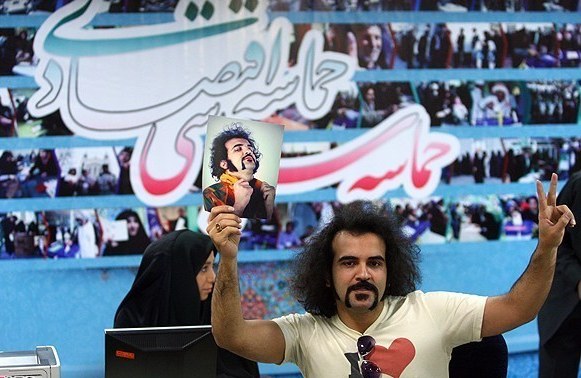
Four Years or Double "V"?

The youngest candidate!

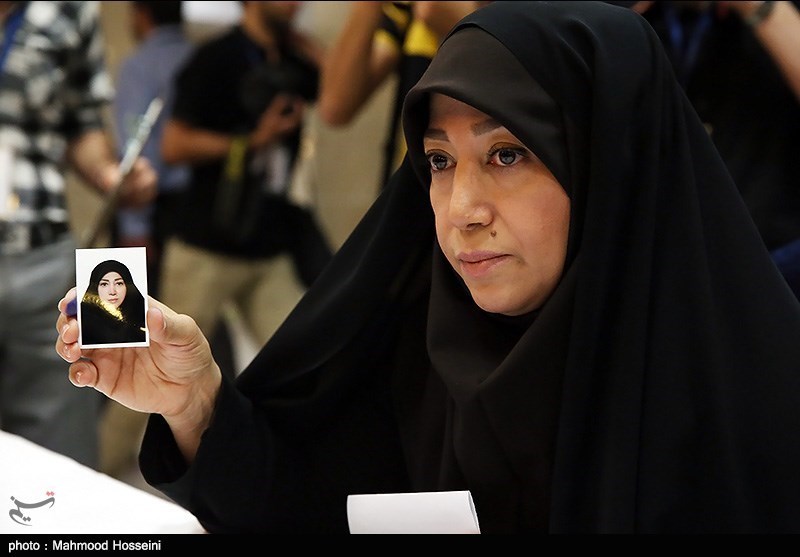
The first woman who nominated herself this year told the reporters: "Do not ask me any political questions!"

Elvis?

A Luti !

Ready to make Iran independent from imported agrarian "strategic" goods!

The book is a copy of the constitution, the documents in the plastic bag, unknown!

Women came with all possible variations of Islamic hijab.

Perhaps being shy is not going to work in his favor!

He shares a name with Behrouz Vosouqi, the great Iranian actor who made the character
of "Qeisar" a hallmark of the Iranian cinema of the 1970s. Mr. Vosouqi, the candidate,
is a "Qeisar" impersonator. 

With his shroud, he is ready for martyrdom on the campaign trail.

He has already introduced the members of his cabinet.


I think she knows that she will not be qualified to run!

Needs to work on the "V" sign!

He does not look too hopeful, either!


LONG LINES!


Already thinking about his victory speech!

Shoes are not required!

Too late for having second thoughts!

Forgot his ID and documents!

Ready with his ad campaign!

With a picture of young Ahmadinejad!

Hope is what keeps man alive!

I like the confidence in the way she walks!

SHE IS IN!

Happy Cleric!

Happier Cleric!

        behrooz ghamari     


Monday, May 6, 2013

Reflecting on Jerry and Me


Professor Mehrnaz Saeedvafa of Columbia College, Chicago, discusses her film  Jerry and Me


CSAMES hosted the first Middle East Film Festival this spring, featuring seven documentaries and six feature films on the Arab world and Iran.  All films were free and open to the pubic.


The Film Festival was funded in part by a grant from the Undergraduate International Studies and Foreign Language program, International Studies Division of the U.S. Department of Education. 


Students of the ARAB/SAME 150 Arab Spring course share their reflections on three of the films below.

---------------------------------------------------------------------------------

By Sarah Elnawasrah

Jerry Lewis, an iconic comedian in Hollywood, left a profound impression on Mehrnaz Saeedvafa as a young Iranian girl. Saeedvafa grows up in a tumultuous family, however she has fond memories of watching the movies every Saturday with her father and grew to love Lewis and his comedic role in all of his movies. In Jerry and Me, Saeedvafa explores her intimate relationship with Hollywood cinema and specifically Jerry Lewis. She interweaves political happenings of Iran as well as her move to the U.S. with clips from Jerry Lewis’ movies. The film comes to light when Saeedvafa sees Lewis in person and she feels a sort of dissonance between what she felt Lewis represented and how he really conducted himself. Ironically, some of his comedic scenes represent deep and personal moments of her life. This overlap of Lewis and Saeedvafa’s voice create a sort of dual-symbolism whereby her current troubles and obstacles are represented through an old Hollywood scene.


Interestingly, The Circle’s director, Jafar Panahi, was one of Saeedvafa’s students in Iran. Panahi creates a powerful image of what it is like to be a woman in modern-day Iran. While the characters he uses are ex-convicts who have just escaped from prison, their problems and obstacles are all too common. As the movie goes on, the narrative switches and the audience observes the different circumstances and life decisions each woman has made. The Circle touches on controversial issues such as pregnancy and abortion, prostitution, and ostracism. The movie comes full circle when we see the pregnant woman from the first scene in the closing scene.            


The Circle and Jerry and Me shed light on personal stories that could happen in Iran or related to Iranian life. Specifically, both films highlight women’s roles and issues in Iran. Saeedvafa touches on her mother’s struggles with her abusive father and her role as a foreign mother with a son in America. In addition, she highlights the U.S.’s political role while living in Iran as well as Iran’s role while living in the U.S. The Circle on the other hand uncovers uncomfortable truths and realities women in Iran face. The film provides foreign audiences with real life issues that could be applicable in any other nation. All in all, The Circle and Jerry and Me are unique in their honesty and relatability.

Sarah Elnawasrah is a junior double majoring in Psychology and Global Studies with minors in Arabic and French.

Women's fight against sexual harassment similar to Arab Spring struggle for dignity


Egyptian actress Bushra in a scene from Cairo 678


By Jasmine Kirby

Cairo 678 is an award winning Egyptian film that tells the story of three women from different parts of Egyptian society and their struggles against sexual harassment. Although the film “678” is not directly about the Egyptian Revolution it discusses many issues in Egyptian society through the framework of different women’s experiences with sexual harassment.

The biggest issue dealt with by the film is obviously the mistreatment of women in Egypt; specifically the pervasiveness of sexual harassment in daily life. Despite the fact that the three main characters came from different socioeconomic backgrounds all three experienced sexual harassment. This demonstrates that this is a problem that can be faced by any woman in Egypt. Similarly, this harassment occurred without much fanfare in locations pivotal to daily life in Egypt such as public transportation and sporting events. It is clear that sexual harassment is not taken as seriously as other crimes in Egypt. Moreover, the commonness of sexual harassment illustrates that change to improving the daily lives of women has always been slow. This demonstrates the Egyptian government's slow response to the injustices felt by its citizens.

Adding to this, another important issue dealt with by the film is the idea of the poor suffering for the transgressions of the rich. This is specifically addressed in the poorer character's complaint that she suffers sexual harassment because men believe she is as “promiscuous” as the richer more Westernized characters. The woman is clearly upset by the rich women's wealth, Westernization and most importantly pushing the limits of traditional gender roles. The divide between the lives of Egypt's richest and poorest played an important role in the cause of the revolution. Moreover, this scene highlights the conservatism of the poor and foreshadows the rise of political Islam in Egypt after the fall of Mubarak.


Overall, through examining sexual harassment in Egypt this film deals with one of the most important causes of the revolution, dignity. After facing harassment, women especially felt the loss of dignity experienced to some extent by all living under a dictatorship. And much like the revolutionaries, the women felt that they had to resort to extreme actions in order to regain their dignity.

Jasmine Kirby is a first year student majoring in History.