Istanbul (image credit: Behrooz Ghamari)

Tuesday, June 11, 2013

IRAN 4 – LEBANON 0


 BEHROOZ GHAMARI 
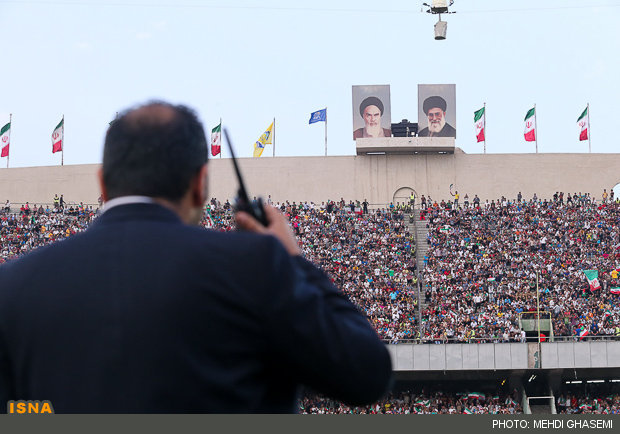
Football crazed Iranians watched their team thrashing Lebanon.
There was a great excitement in Blogistan about today’s game between Iran and Lebanon. Iran needed a big win in order to keep its hope alive to qualify for next year’s World Cup in Brazil. The excitement in social media was mostly about the possibility of close to 100,000 people congregating without police interference. The hope was that the event will turn into a protest platform and the cheering crowd will take political advantage of the soccer game.
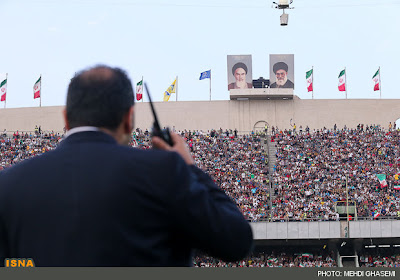
Security is always tight in these kind of games. Often those who are there to enjoy the game outnumber those who look at these gathering as a political opportunity
It turned out, as expected, that the 100,000 strong crowd was mostly interested in seeing more goals in the field rather than redefining the goals of the election. Iran won and the election will go on as scheduled. Though there still three more days is left to the election day on June 14.

My experience with Iran is that the social media often create a twisted picture of the realities and potentials on the ground. But here I don’t want to get that much into my analysis of the fallacies of cyber politics.
The Dutch-Iranian striker Reza Ghoochannejhad is the new sensation in Iran. He scored a goal today.
The Iranian team Captain is Javad Nekounam, who has played for many years in the Spanish premier club Osasuna.
The Portuguese coach of the National Team, Carlos Queiroz, was literally pushing the players to score more goals. His job depends on whether Iran qualifies for the World Cup or not. 

No, these are not the supporters of the famous Iranian Green Movement (though they might as well be).  They are just celebrating the 4-0 victory over Lebanon with an Iranian flag the top part of which is green.
Women are not allowed in football stadiums in Iran, but that does not stop them from taking part in celebrations. If you have not seen Jafar Panahi's film "Offside," do check it out. It is a complex look at the gender politics of sport spectators.
The other big winner yesterday was Mohammad Reza Aref who ended his campaign in favor of Hassan Rohani.  Aref has had indicated in the past that if the leader of the reform movement, former president Khatami, asks him to step aside in favor of another candidate, he will. Khatami finally asked, he consented. Now for all practical purposes, Rohani can rest assured that he will bag the votes of Aref in the first round. At this point Rohani, who is now endorsed by both Rafsanjani and Khatami, will most likely survive the first round, though some are overly optimistic thinking he might even win more than 50% and get elected directly with no need for a second round. 
Now a wide varieties of endorsements have been generated for Mr. Rohani. Aref emphasized that "based on the request of the leader of reform [Khatami], I step aside."

I am sure that now the other side will try to reach an agreement to rally around one or two candidates, perhaps Qalibaf and Velayati. 

At this point, the rule of the thumb is that if a candidate cannot pack a stadium, he won’t have any chances of winning the election. In that front, Rohani is far ahead of his opponents.

Rohani supporters in a sports arena in Shiraz. Now Rohani easily packs these arenas and in most places an overflow of enthusiasts have to stay outside.
 I also want to mention here how disappointing the coverage of the campaign in the American media has been (shocking, no?). Often stories about the candidates emphasize that there is not much difference between them. That is not true. It is true that all candidates believe in the constitution of the Islamic Republic and none has any plans to change the system. But in terms of their understanding of the constitution and how the existing system must operate domestically and internationally, they differ quite significantly. I can say with a high degree of certainty that the different between the positions of Mr. Rohani and Mr. Jalili is much greater than that of President Obama and Mitt Romney, for example.

The New York Times basically frames the election in terms of Iran’s nuclear policy. What determines the candidates’ politics is their position on the enrichment program and Iran’s right to nuclear proliferation. This is quite shortsighted and wrong. One thing that became clearer during the campaign was that no candidate could afford not to be critical of the current conditions, not to defend the basic principles of civil liberty, and not to advocate less government intervention in peoples’ every day lives. This was quite an achievement. The fact that people can openly speak about these issues (such as release of political prisoners, gender equality, freedom of the press, etc.) shows that overall the election season has moved the center toward the “Left” (this is a complicated issue, what is Left and what is Right in Iran). The Times journalists need to understand that what is good for Iran might not necessarily be good for the United States. There are places that the interests of the two countries coincide, that is fine and that needs to be highlighted. But Iranians are electing a president for their own country, they are not voting for someone who will safeguard American interests in the region and in Iran.

I wonder what counts for the Times reporters and columnists as a "hard line on nuclear might!"
The Washington Post’s coverage is more nuanced and sophisticated. However, they rely too much on the expert knowledge of think tanks who follow particular political agenda.

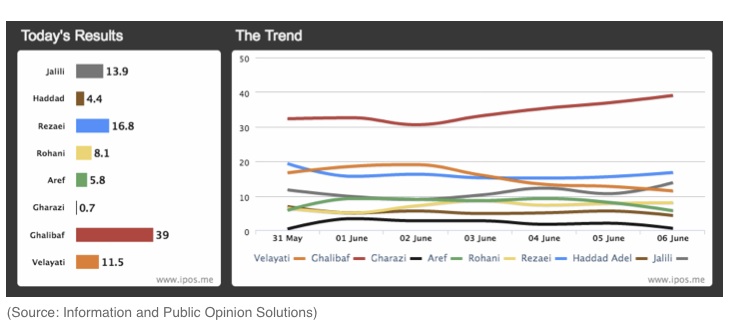
I have been following the polls in Iran very closely. Even the most conservative pollsters do not claim that Qalibaf is the "runaway favorite." In a great majority of polls Rohani is the frontrunner followed by either Aref or Qalibaf.

Let me finish by congratulating the Iranian national team for offering an exhilarating evening to 100,000 people in Azadi Football Stadium. 


Sunday, June 9, 2013

THE SPARK!


 Behrooz Ghamari 
Highlights from the last debate on the front page of a Tehran newspaper: Velayati: The result of Mr. Jalili's nuclear negotiations is more sanctions and more pressure on the people. Aref: The almighty gave me the strength to hold my meaningful silence against the events of the last presidential election. We must never use a stick against each other. Rezaei: Mr. Haddad speaks in the language of slogans, he can resist as much as he wants, but people are hungry.
After three debates and much publicity on the radio and television (every candidate gets exactly the same length of airtime of close to 5 hours from the state-run radio and television, they are not allowed to purchase additional time) the campaign feels quite real and heated. 

The third and last live TV debate finally spread the election fever across the country. Focused mostly on foreign relations, the debate generated heated discussions on a number of issues, most importantly on the negotiations with Western powers over nuclear proliferation. The most shocking moment of the debate was Ali Akbar Velayati’s biting criticism of Mr. Jalili’s failure as the chief negotiator to close the file on nuclear negotiations. We need to remember that Velayati is a two-time minister of foreign affairs and a trusted adviser and a close ally of the Supreme Leader. Jalili prides himself as the only negotiator who has carried out the wishes of the Supreme Leader to the fullest. Jalili campaigns on the strength of his uncompromising position under the slogan of “resistance with teachings of Islam.”

In a brilliant passage, Velayati reminded Jalili that “a negotiation table is not a philosophy class. You should not pat yourself on the back because your logic was superior to theirs. People want to know what you have actually achieved.”
Velayati, a physician with specialization in infectious diseases from Johns Hopkins University, is clearly separating himself from the 2+1 coalition and from the neo-conservatism of Jalili and Ahmadinejad. 

Now we can see that three distinct lines has emerged.

First, and so far the most successful, is the reformist line represented by Aref and Rohani. As the campaign progresses, both candidates are becoming more candid and assertive in their critique of Ahmadinejad’s two-term administration and his supporters in the principlist/neo-conservative camp. The main themes in their critique are: the suppression of freedom of expression, erratic and failed economic policies, confrontational and provocative foreign policy, which relates back to the pressing economic concerns of most Iranians.

Aref: “They wanted to bring the oil money to people’s table, instead they took their bread away!” Rohani: “They wanted to ensure that the wheels of enrichment of uranium continued to turn, but they broke the wheels of our economy by encouraging sanctions and creating a hostile environment.”

Second, are the traditional conservatives who appear to be more accommodationist and do not intend to eliminate the reformists from the polity. This line was mostly absent after the Guardian Council vetted the candidates. But now, Velayati, Tehran Mayor Qalibaf, and Mohsen Rezaei, the former chief of the revolutionary guards, are trying to situate themselves as the representatives of this line. Qalibaf, an original member of the 2+1 coalition, has now tried to distance himself from the neo-conservatives, although to me, he remains a wildcard. The traditional conservatives’ criticism of the reformists is that they are elitist, and that during Khatami administration they monopolized power by putting their own operatives in charge of every single office in the entire state bureaucracy (“The only people who kept their jobs were the janitors”).

Third, are the principlist or neo-conservatives represented by Jalili and Haddad. Both of these have performed poorly in the debates and keep losing support. Haddad was never a serious contender. But Jalili operates with an organized campaign and has the endorsement of influential principlist ayatollahs. They call themselves principlists because they believe that they are the only true followers of the Supreme Leader and that they never retreat from the basic principles of resistance and revolutionary Islam. It is interesting that Jalili and Hadda borrow their rhetoric from Khomeini’s revolutionary discourse, but their support in the clerical establishment comes from those who opposed Khomeini and his revolutionary zeal.

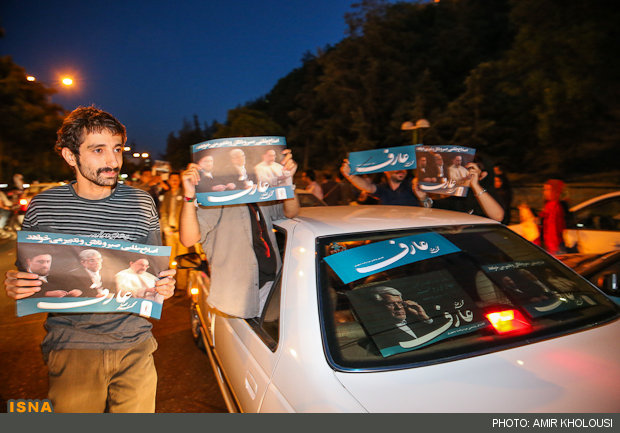
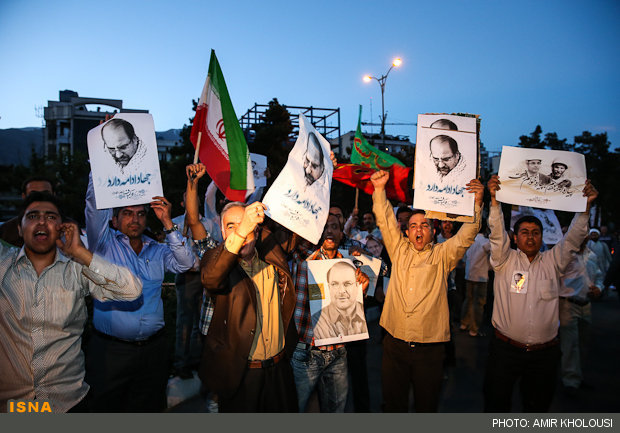
But what is important is that the last debate has now generated a nationwide enthusiasm about the election. Although the police has banned late night carnivals, Tehran and other major cities around the country is a scene of campaign festivities. People of all walks of life, young and old, rich and poor, educated and otherwise pour into the street defending their favorite candidate. The newspapers and blogs report that these gatherings have been peaceful and without police interference. 


Photos show outside the television station during and after the third debate.

The two reformist candidates, Aref and Rohani, were supposed to announce the formation of a coalition yesterday. But it seems like both insist on continuing their campaign.

Yesterday, after they failed to reach an agreement, former president Khatami told a group of reporters that rather than their own ambitions the candidates should think about the interests of the nation.

The key that symbolizes Rohani's campaign is becoming more and more ornamented!
Under the watchful eyes of Ayatollah Khomeini, Rohani promises a government of "thoughtfulness and hope!"
Both Aref and Rohani are now easily able to pack small stadiums!
A woman holding a Jalili photo on the bus. Now every little opening any where in the city is considered to be a campaign opportunity
Jalili poster working as a burqa!
Campaigning while waiting for the green light.
Blue is the color of Rezaei. Although he has proven to be a good debater, he has been having a hard time to improve his standing in the polls.
As if getting into the major metro stations were easy before. Try it now!
Strolling in the park on behalf of the Mayor Qalibaf!
Qalibaf also knows the significance of women's vote quite well.
Doctors do not recommend participating in any campaign rally after a nose job!
The thinker is totally blurred in this scene!
Rohani enthusiasts.
Late for work, early in the morning, Tehran metro station!

The increasing popularity of Qalibaf.
Jalili supporters usually need to shout louder to compensate for smaller numbers!
Apparently Jalili's call for resistance still resonates with many youth in Iran.
The reformists now hope that they can win the election in the first round! Wishful thinking?
Many in Iran wish that they could live under perpetual election season where every one is friendly, even the police and drivers on busy streets.
Zahra Eshraqi, Khomeini's grand daughter, is the head of the National Organization of Reformist Youth.  She announced yesterday that the reformist candidates for Tehran City Council election agreed on a single list and have a great chance of retaking the majority in the Council.