Istanbul (image credit: Behrooz Ghamari)

Sunday, June 9, 2013

THE SPARK!


 Behrooz Ghamari 
Highlights from the last debate on the front page of a Tehran newspaper: Velayati: The result of Mr. Jalili's nuclear negotiations is more sanctions and more pressure on the people. Aref: The almighty gave me the strength to hold my meaningful silence against the events of the last presidential election. We must never use a stick against each other. Rezaei: Mr. Haddad speaks in the language of slogans, he can resist as much as he wants, but people are hungry.
After three debates and much publicity on the radio and television (every candidate gets exactly the same length of airtime of close to 5 hours from the state-run radio and television, they are not allowed to purchase additional time) the campaign feels quite real and heated. 

The third and last live TV debate finally spread the election fever across the country. Focused mostly on foreign relations, the debate generated heated discussions on a number of issues, most importantly on the negotiations with Western powers over nuclear proliferation. The most shocking moment of the debate was Ali Akbar Velayati’s biting criticism of Mr. Jalili’s failure as the chief negotiator to close the file on nuclear negotiations. We need to remember that Velayati is a two-time minister of foreign affairs and a trusted adviser and a close ally of the Supreme Leader. Jalili prides himself as the only negotiator who has carried out the wishes of the Supreme Leader to the fullest. Jalili campaigns on the strength of his uncompromising position under the slogan of “resistance with teachings of Islam.”

In a brilliant passage, Velayati reminded Jalili that “a negotiation table is not a philosophy class. You should not pat yourself on the back because your logic was superior to theirs. People want to know what you have actually achieved.”
Velayati, a physician with specialization in infectious diseases from Johns Hopkins University, is clearly separating himself from the 2+1 coalition and from the neo-conservatism of Jalili and Ahmadinejad. 

Now we can see that three distinct lines has emerged.

First, and so far the most successful, is the reformist line represented by Aref and Rohani. As the campaign progresses, both candidates are becoming more candid and assertive in their critique of Ahmadinejad’s two-term administration and his supporters in the principlist/neo-conservative camp. The main themes in their critique are: the suppression of freedom of expression, erratic and failed economic policies, confrontational and provocative foreign policy, which relates back to the pressing economic concerns of most Iranians.

Aref: “They wanted to bring the oil money to people’s table, instead they took their bread away!” Rohani: “They wanted to ensure that the wheels of enrichment of uranium continued to turn, but they broke the wheels of our economy by encouraging sanctions and creating a hostile environment.”

Second, are the traditional conservatives who appear to be more accommodationist and do not intend to eliminate the reformists from the polity. This line was mostly absent after the Guardian Council vetted the candidates. But now, Velayati, Tehran Mayor Qalibaf, and Mohsen Rezaei, the former chief of the revolutionary guards, are trying to situate themselves as the representatives of this line. Qalibaf, an original member of the 2+1 coalition, has now tried to distance himself from the neo-conservatives, although to me, he remains a wildcard. The traditional conservatives’ criticism of the reformists is that they are elitist, and that during Khatami administration they monopolized power by putting their own operatives in charge of every single office in the entire state bureaucracy (“The only people who kept their jobs were the janitors”).

Third, are the principlist or neo-conservatives represented by Jalili and Haddad. Both of these have performed poorly in the debates and keep losing support. Haddad was never a serious contender. But Jalili operates with an organized campaign and has the endorsement of influential principlist ayatollahs. They call themselves principlists because they believe that they are the only true followers of the Supreme Leader and that they never retreat from the basic principles of resistance and revolutionary Islam. It is interesting that Jalili and Hadda borrow their rhetoric from Khomeini’s revolutionary discourse, but their support in the clerical establishment comes from those who opposed Khomeini and his revolutionary zeal.

But what is important is that the last debate has now generated a nationwide enthusiasm about the election. Although the police has banned late night carnivals, Tehran and other major cities around the country is a scene of campaign festivities. People of all walks of life, young and old, rich and poor, educated and otherwise pour into the street defending their favorite candidate. The newspapers and blogs report that these gatherings have been peaceful and without police interference. 


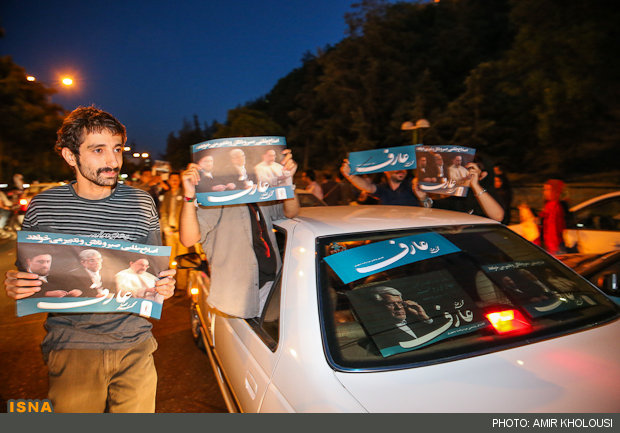
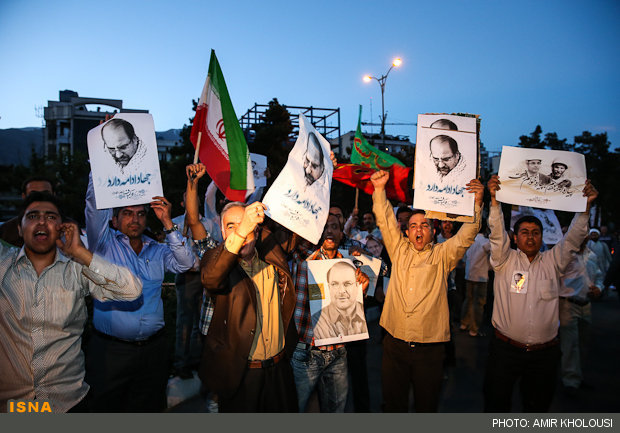
Photos show outside the television station during and after the third debate.

The two reformist candidates, Aref and Rohani, were supposed to announce the formation of a coalition yesterday. But it seems like both insist on continuing their campaign.

Yesterday, after they failed to reach an agreement, former president Khatami told a group of reporters that rather than their own ambitions the candidates should think about the interests of the nation.

The key that symbolizes Rohani's campaign is becoming more and more ornamented!
Under the watchful eyes of Ayatollah Khomeini, Rohani promises a government of "thoughtfulness and hope!"
Both Aref and Rohani are now easily able to pack small stadiums!
A woman holding a Jalili photo on the bus. Now every little opening any where in the city is considered to be a campaign opportunity
Jalili poster working as a burqa!
Campaigning while waiting for the green light.
Blue is the color of Rezaei. Although he has proven to be a good debater, he has been having a hard time to improve his standing in the polls.
As if getting into the major metro stations were easy before. Try it now!
Strolling in the park on behalf of the Mayor Qalibaf!
Qalibaf also knows the significance of women's vote quite well.
Doctors do not recommend participating in any campaign rally after a nose job!
The thinker is totally blurred in this scene!
Rohani enthusiasts.
Late for work, early in the morning, Tehran metro station!

The increasing popularity of Qalibaf.
Jalili supporters usually need to shout louder to compensate for smaller numbers!
Apparently Jalili's call for resistance still resonates with many youth in Iran.
The reformists now hope that they can win the election in the first round! Wishful thinking?
Many in Iran wish that they could live under perpetual election season where every one is friendly, even the police and drivers on busy streets.
Zahra Eshraqi, Khomeini's grand daughter, is the head of the National Organization of Reformist Youth.  She announced yesterday that the reformist candidates for Tehran City Council election agreed on a single list and have a great chance of retaking the majority in the Council.

Monday, June 3, 2013

SOMETHING IS BREWING!


Frontpage of Tehran newspaper E'temād, "Longing for a Debate: The television turned an important political even into an entertainment program." "A half debate, half standardized test."


Two nights ago, the first (of the three scheduled presidential debates orchestrated by the state television) aired. The four-and-a-half hour debate between 8 candidates was simply put a disaster. The candidates were surprised to learn that everything from the set of the debate to its format was designed like a game show (It was actually directed by a famous game-show host!). There were four different stages to this game show. First, each candidate was given three minutes to respond to a variety of questions, then they were all shown a random picture and asked to comment what they see in the picture (is this a therapy session?!), after that each was given a set of multiple choice questions (“is this a standardized test?” one of the candidates asked), and if that were not enough the program ended with a series of true or false series of questions!
Everyone scored a point by attacking Ahmadinejad. Here is a cartoon from the front page of Qanun.  The captions read: "Hunting Mahmoud (Ahmadinejad)! Quarter finals of the presidential race: This guy doesn't have a tribune, go for his eye!"
By the last segment, Mohammad Reza Aref, one of the two broadly-defined reformist candidates, had had enough. He refused to answer multiple choice and true-false questions arguing that “this is not a high school exam!” After the debate, a wave of letters and editorials in the newspapers of competing factions chastised the debates as a cheap show that tried to de-politicize the election by avoiding serious conversations. A number of parliamentarians also called for the Head of the Radio and Television to apologize for making a mockery of the nation’s electoral process.

Meanwhile, the conservative 2+1 coalition (Velayati-Haddad-Qalibaf) announced yesterday that they have officially abandoned efforts to agree on one candidate. All three candidates of the former coalition are now running solo.

Jalili continues to operate as a mystery candidate for those conservatives who once supported Ahmadinejad and then became disillusioned with him, as well as those who defend Ahmadinejad and would like to see the extension of his populist and confrontational policies. Many in Tehran still wonder whether Mr. Jalili is Ahmadinejad’s Trojan horse or not. The influential Tehran university political science professor, Sadeq Ziba-Kalam, called Mr. Jalili “at best, a good associate dean of education for his alma mater Imam Sadeq University” (established by the Revolutionary Guards for the education of its own cadres). 

Jalili is representing himself as the candidate of "resistance!" "We are already behind the enemies tents," he said recently in a campaign speech. 
But the more exciting news comes from the reformists campaign. Both candidates, Aref and Rohani, have upped the rhetoric and now speak more freely and assertively about their reformist credentials. Last night at Jamaran Mosque, Rohani, the only cleric running, sounded openly defiant and called himself a candidate who will continue the political and economic reforms initiated under Rafsanjani and Khatami administrations. He also told a young and rowdy audience that he will not allow a repeat of the 2009 election. “I will protect,” he told his cheering audience, “your votes.” He also declared that he will not allow Mr. Mousavi and Karrubi, the two 2009 presidential election contenders, to remain under house arrest. After his talk, people continue to shout slogans in defense of Mousavi and Karrubi. The police arrested 13 people. One report indicates that they were all released after a few hours. Some bloggers reported that the arrested were members of the youth campaign for Rohani and they were all transferred to Evin prison.

Rohani entering Jamaran Mosque

OK, they won't win the contest for the best fashion show, but Rohani is mobilizing a committed group of young people to generate some excitement on behalf of his campaign. 

"A Key" also symbolizes Rohani's campaign. He is offering a key to resolving the economic problems, as well as a key to open the prison doors. He openly talks about ending the house arrest of Mousavi and Karrubi, the 2009 presidential candidates who have been under house arrest for more than two years now.

Rohani holds the key, does he?
One way we can gauge the changes is the rapidly increasing involvement of women in the campaign. Rohani has chosen the color purple for his campaign and one can see suddenly many purple ornaments hanging from people’s attire on the streets, especially women.

Women at a Rohani campaign speech. Rohani, the only cleric running for presidency, has been able to mobilize women groups better that his opponents.

Purple is the color! Is there going to be a purple movement?

As much as Rohani believes he holds the key to solving numerous political and economic problems in the country, he should also be conscious of the fact that women hold the key to any possibility of his success in the election.

Women know that who the president is makes a distinct difference in the way they are allowed to appear in public. 
Qalibaf also tries to appeal specifically to women. In all his campaign stops, there are significant number of women cheering for him. 

Women students welcoming Qalibaf at Amol University campus. The poster reads: "With you one can enter the sea!" (an expression in Farsi meaning that we will stand by you in your efforts). It would be interesting to see how would these women do this on the segregated beaches of Caspian Sea!

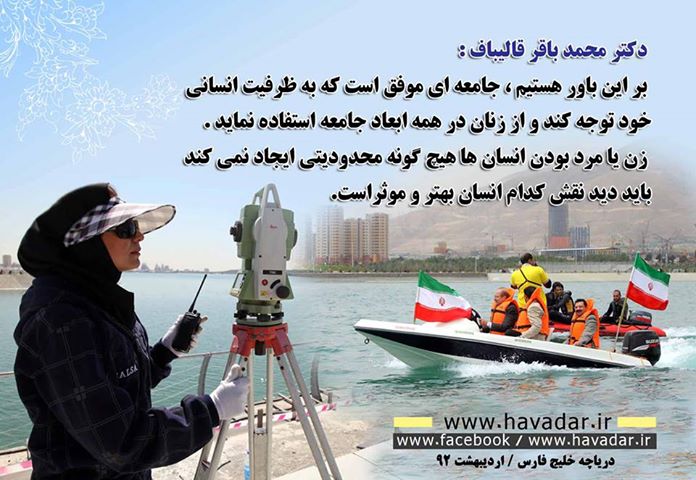
Qalibaf campaign poster. "We believe that a society is successful when it is able to pay attention to its human capital and allow women to enter all dimensions of social life. To be woman or a man must not create a limitation for any one. We must see which member of society is better and more effective."
Mr. Aref also rode the metro to Tehran’s old Bazaar. He was cheered by fellow passengers and welcomed by hundreds of Bazaar merchants, who traditionally support more conservative factions in the government. A number of merchants were also arrested after Aref’s visit, but released after a few hours.

Aref entering the metro station. You can see that he has paid his fair. Metro in Tehran is heavily subsidized. A single ride costs only a quarter.
Metro rides in Tehran are not for the faint-hearted, especially if you are running for the presidency and eager citizens question you on your ride!

With god's grace, the new metro cars in Tehran are air conditioned!

Yes, women can ride with men on the same car, but there are also women only cars for those who prefer the segregated space. Metro now is also a bustling space for women's businesses. Women vendors sell all kinds of things particularly in women only cars.

The public transportation etiquette in Iran is that younger people should offer their seats to the elderly. Aref is trying to persuade the young man that he is not that old despite his silver hair!

No, this is not a rally. People just exiting the metro station at Tehran Bazaar.
How many kisses on the cheek a presidential candidate can take?

Suddenly, from being thrown out of the race by Rafsanjani’s disqualification, the reformists see the possibility of an opening. If they are successful in forming a coalition with one candidate, then they might as well be able to take the election into a second round and a possible upset victory. That is hopeful thinking, but now that kind of hope does not seem totally baseless.


Saturday, June 1, 2013

WHO IS THE SUPREME LEADER’S MAN?


Saeed Jalili entered the race at the last minute and has emerged as a viable candidate. Yesterday he received the endorsement of Ayatollah Mesbah Yazdi the ideological and religious father of the conservative principlists. Yazdi was an uncompromising supporter of Ahmadinejad and on numerous occasions had called his presidency "the will of the absent Imam," the Shi‘a Messiah. 

The guessing game continues in Tehran as the three competing conservative factions try to represent their candidate as the one favored by the Supreme Leader. Last week, it appeared that Ayatollah Khamenei was priming the nuclear negotiator Saeed Jalili to become the next president. This week, however, the conservative papers as well as the reformists began to suspect that Jalili was acting as Ahmadinejad’s sleeper cell. While all eyes were on Masha’ei as Ahmadinejad’s Medvedev, a number of editorials suggested that Ahmadinejad successfully got the Guardian Council to qualify Jalili to run. If that is the case, the Supreme Leader will have a difficult time to throw his support behind a man who is also supported by Ahmadinejad, given that the outgoing president is now officially the black sheep of the principlist conservatives. Almost no one among the conservative elites trusts Ahmadinejad any more. What ever he touches turns to dust.

The 2+1 coalition from right to left: Mohammad-Baqer Qalibaf, Tehran's mayor, Ali-Akbar Velayati, former foreign minister and a trusted adviser of Ayatollah Khamenei, Haddad Adel, former speaker of the majles, and a close ally of Ayatollah Khamenei.
And then there is still the conservative coalition known as the 2+1. Originally, the plan was that from the three candidates of this coalition, two would step aside and endorse the third one at the end of the qualification process. Now that all three are qualified, none is willing to endorse the other. All three want to become the president. Yesterday, after a three-hour meeting all three reiterated that none is stepping aside in favor of the others. 

2+1 was supposed to represent the Supreme Leader’s wish, but now with friction appearing within the coalition and each candidate considering himself the best option, no one knows which one the Supreme Leader will eventually bring under his robe!

Qalibaf presents himself as a candidate of all classes. He tries particularly to appear appealing to Tehran's large middle class with a significant electoral weight.

In every single poll conducted by the conservative think tanks, the charismatic member of 2+1, Tehran’s mayor Mohammad Qalibaf, is substantially ahead of his other conservative rivals. But Qalibaf also is a wild card. He has ambitions of his own and is unlikely to become the “yes-man” of the Supreme Leader. 

The Supreme Leader has already learned from his experience of the last Tehran mayor to become president (Ahmadinejad), that he must empty the office of presidency from an institution of independent thinking. In effect, he wants to turn the office of the president officially into the executive wing of the Supreme Leader. After the last election in 2009, Ayatollah Khamenei made it clear that he will no longer tolerate a reformist president. Now his predicament is how to make his wishes a reality in an electoral process that remains unpredictable and difficult to manipulate.